
Business
Delhi-Agra Vande Bharat set for speed upgrade
By Marcus Chen
Advertisement · Why this ad?
Katherine oversees editorial operations across all six brands. Before joining The Meridan Group, she spent 14 years at the Minneapolis Star Tribune, where she led the metro desk through its digital transformation. She holds a Master's in Journalism from Northwestern's Medill School.
More from Katherine →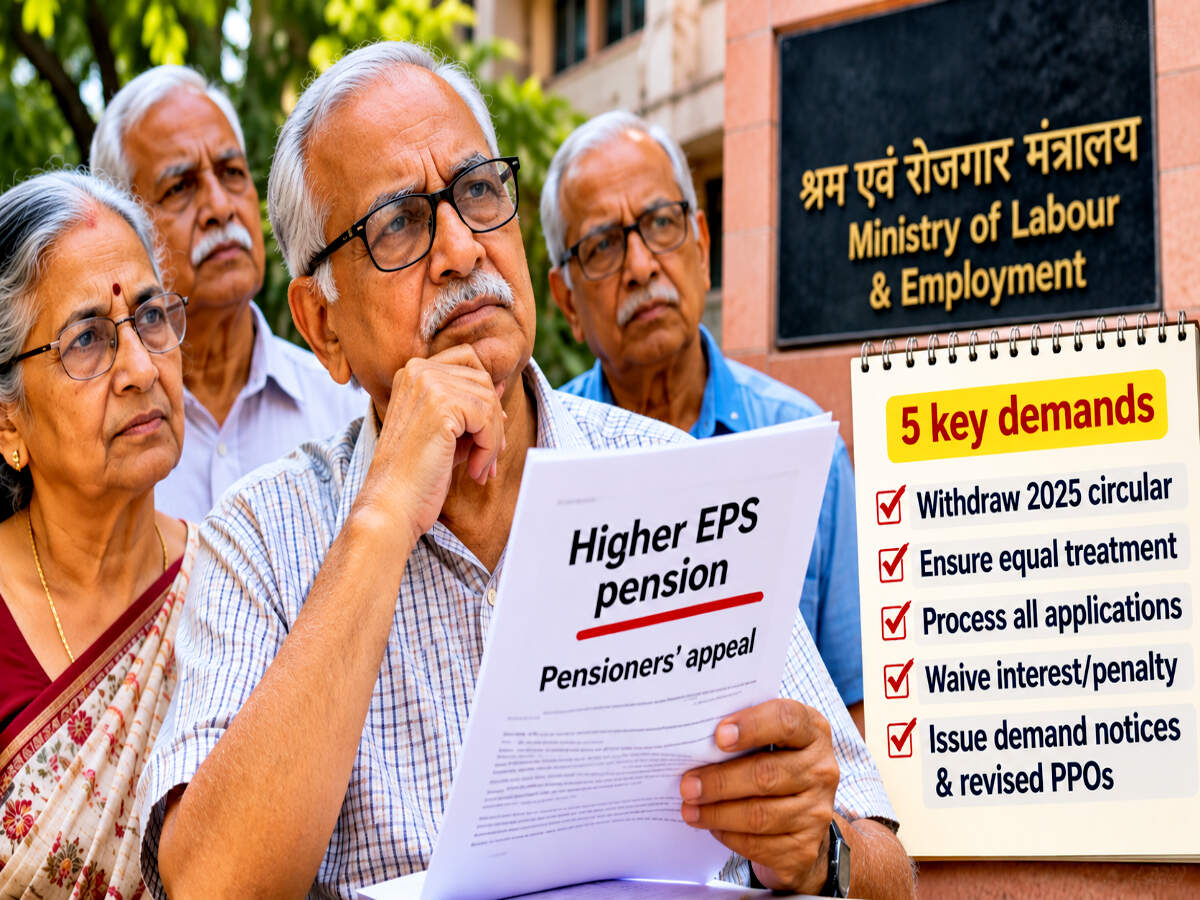
Synopsis The National Confederation of Pensioners' Associations has requested the Labour Ministry's urgent intervention in pending pension cases. They seek to withdraw a circular from January 2025 that affects higher EPS pension eligibility. The NCPA emphasizes eliminating discrimination between exempted and unexempted establishments regarding pension rights. They have proposed several recommendations to streamline the processing of pension applications and address delays. Listen to this article in summarized format Listen ET Online A prominent pensioners’ body representing PSU and private sector employees has sought immediate intervention of the Labour Ministry in the long-pending cases of higher Employees’ Pension Scheme (EPS) for employees from exempted establishments. In a letter dated November 7, 2026, to Mansukh Mandaviya, the Minister of Labour & Employment, the National Confederation of Pensioners' Associations (NCPA) has requested the ministry to withdraw the Employees’ Provident Fund Organisation’s ( EPFO ) January 2025 circular that mandates internal trust rules to determine higher EPS pension criteria for employees from exempted establishments. Giving reference to various cases where courts have said that provident fund rules can’t govern pension rights, the NCPA stresses that courts have also clarified that exempted and unexempted establishments stand at par when it comes to approving higher EPS pension cases for employees. Also Read: 8th Pay Commission news: Notified a year ago, 5 biggest 8th CPC developments since November 3, 2025 The NCPA has thus given five recommendations to the Ministry to approve all higher EPS pension cases of employees from exempted establishments. 1. Withdraw/ r escind c ircular d ated January 18, 2025 The NCPA has requested to formally withdraw the directive that mandates reliance on internal PF trust rules to determine higher EPS pension eligibility. The NCPA writes that the withdrawal of the circular will also clarify to field offices that internal trust ceiling clauses cannot be used to reject higher pension cases. The NCPA says that, because of this circular, the EPFO is stopping many higher pension cases, citing that historical internal trust rules of an exempted establishment strictly mirrored the statutory wage ceilings. 2. Eradicate “class within a class" discrimination The NCPA has requested the Labour Ministry to issue instructions ensuring parity between exempted and un-exempted establishment retirees as mandated under the Supreme Court and High Court directives. Also Read: Government clarifies GPF rules for deceased employee’s claim: Ministry reveals who among family members and nominees get GPF money The NCPA says that in many higher EPS pension court verdicts, including in Bombay High Court’s October 19, 2026, decision in Amit Gunvantrai Mehta & Ors. Vs. EPFO case, it has been said that provident fund trust rules cannot govern pension rights, and exempted and unexempted establishments stand on par in terms of approving higher EPS pension applications. "The EPFO cannot reject higher EPS pension applications on the ground that trust rules either cap employer contributions or omit enabling provisions for joint options," the letter reads. 3. Universal p rocessing of e xempted a pplications In the letter, the NCPA has also requested the Labour Ministry to direct all regional offices to process and approve joint higher EPS pension applications from exempted establishments in a uniform manner. 4. Waiver of p enalty/ i nterest The NCPA says that if the higher EPS pension case of an exempted trust employee is delayed by the EPFO administration, the employee should be given a full waiver of any additional interest burden. Also Read: 8th Pay Commission: 6 key demands by Railway employee's body; better pay, merging of pay scales, hardship allowance and more Under the higher EPS pension option, the pension contribution is recalculated on the employee's actual salary rather than the applicable statutory wage ceiling. An EPS member needs to deposit this difference into their pension fund. Since this differential amount is deposited for earlier years, the EPFO also charges interest on the outstanding contribution. What the NCPA is saying is that since the delay is because of the EPFO and not from the employee’s side, such interest should be waived off. 5. Immediate issuance of demand notices & PPOs In a crucial demand from the Ministry, the NCPA seeks to expedite issuance of demand notices and revised Pension Payment Orders (PPOs) to deliver arrears and monthly pensions to senior citizens without further litigation. What the NCPA implies here is that the pension amount that pensioners have lost because of a delay in the approval of higher EPS pension cases should be given soon in the form of arrears. The NCPA also requests the Ministry to issue revised PPO orders showing a higher EPS pension amount for employees from exempted establishments. (Join our ETWealth WhatsApp channel for all the latest updates) Add as a Reliable and Trusted News Source Add Now! Read more news on eps pension increase proposal 2026 eps pension eps 95 eps 95 pension epfo epf eps meaning eps full forn eps 95 latest news eps 95 pension latest news today (Catch all the Personal Finance News , Breaking News , Budget 2025 Events and Latest News Updates on The Economic Times .) Subscribe to ET Prime and read the ET ePaper online. ...more Add Comment
By Marcus Chen

By Katherine Langford

By Marcus Chen

By Katherine Langford